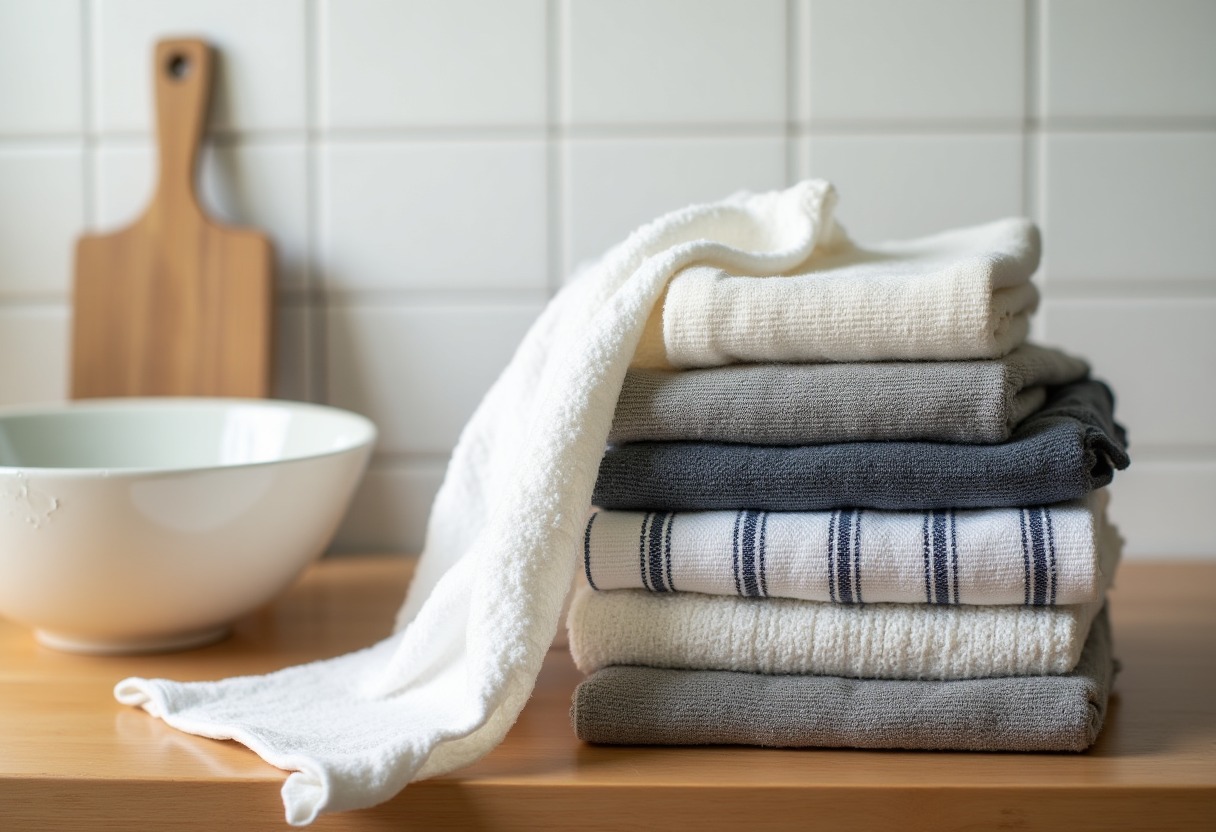
Most kitchen towels either push water around without absorbing it or leave lint all over your glassware. The wrong towel turns a simple task like drying dishes into a frustrating cycle of rewashing and re-drying, while the right one disappears into your routine because it just works.
Why Material and Weave Actually Matter
Kitchen towels aren't just fabric rectangles. The fiber type determines absorbency potential, while the weave pattern affects how quickly the towel picks up moisture and how much lint it sheds. Cotton remains the standard for kitchen towels because its natural fibers hold roughly 27 times their weight in water when properly woven, though this capacity drops significantly if the towel uses short-staple cotton or tight weaves that prevent water penetration.
Flour sack towels use a simple plain weave with loosely twisted cotton yarns, creating gaps that pull water in through capillary action. They're thin enough to wring out completely and dry fast, which matters when you're cycling through multiple towels during meal prep. Microfiber towels use synthetic polyester and polyamide fibers split into microscopic strands that create exponentially more surface area—the reason they absorb water efficiently despite feeling less plush than cotton.
The weave pattern changes everything about performance. Terry cloth loops trap water but also trap food particles and take forever to dry, creating bacterial growth conditions. Waffle weave creates a grid of raised squares that increase surface area by roughly 40% compared to flat weaves while maintaining quick-dry properties. Herringbone and twill weaves sit in the middle—decent absorption, moderate lint, reasonable durability.
Matching Towel Type to Task
Different kitchen jobs need different towel properties. Drying cast iron after washing (something I cover extensively in Best Cast Iron Pans Everyday Cooking) requires a lint-free surface and high absorbency—flour sack cotton wins here. Cleaning counters after working with your compost bin needs something you can rinse and reuse immediately without bacterial buildup, where microfiber excels.
→ Shop flour sack dish towels on Amazon
For glassware and wine glasses, you need zero lint and enough grip to polish without slipping. Waffle weave cotton or dedicated glass towels made from tightly-woven smooth cotton work best. Terry cloth belongs nowhere near glass.
Handling hot pots and baking sheets requires thickness without bulk. A folded flour sack towel provides enough insulation for moderate heat, but anything coming out of a Dutch oven (see Best Dutch Ovens Everyday Cooking Baking) needs a dedicated oven mitt or a thick bar mop towel folded several times.
Performance Comparison: Cotton vs. Microfiber vs. Blends
| Material Type | Absorption Speed | Lint Production | Durability (Washes) | Best For | |---------------|------------------|-----------------|---------------------|----------| | Flour Sack Cotton | Fast (3-4 seconds) | Minimal after break-in | 200-300+ | Drying dishes, handling produce, covering dough | | Microfiber | Very Fast (1-2 seconds) | Nearly zero | 150-200 | Counter cleaning, stainless steel polishing, glass | | Waffle Weave Cotton | Moderate (4-5 seconds) | Low | 300-400+ | All-purpose drying, hand towels, delicate surfaces | | Terry Cloth | Slow (6-8 seconds) | High | 250-350 | Spill cleanup (not recommended for dishes) | | Cotton-Linen Blend | Moderate (5-6 seconds) | Medium (decreases over time) | 400+ | Everyday drying, decorative use, hand towels |
The numbers matter. Flour sack towels absorb their weight in water within seconds when properly broken in (they need 2-3 washes to reach full absorbency). Microfiber towels lift water even faster but lose effectiveness once saturated, while cotton towels maintain performance even when damp. Durability counts more than initial softness—a towel that lasts 300 washes at $2 each costs you less per use than a $12 towel that pills after 50 cycles.
→ Shop microfiber kitchen towels on Amazon
The Best Kitchen Towel Types Worth Buying
Classic Flour Sack Towels: These 100% cotton flat-weave towels measure roughly 28x28 inches when unfolded. Buy them in bulk (packs of 12 or more) for around $1.50-$2 per towel. They start stiff but become incredibly soft and absorbent after a few wash cycles. You can bleach them without damage, they dry in under an hour when hung, and they fold small enough to store a dozen in one drawer. I keep a rotating stack of 15 and wash them every 2-3 days.
Waffle Weave Kitchen Towels: The textured grid pattern provides excellent grip for drying dishes and enough absorption for most spills. Quality waffle weave towels measure 16x24 inches or larger and use ring-spun cotton rather than open-end cotton (you'll feel the difference in hand). These cost $3-5 each but last significantly longer than flour sack versions because the weave structure resists tearing.
→ Shop waffle weave kitchen towels on Amazon
Microfiber Glass Towels: Not for general kitchen use, but essential for polishing glassware, stainless appliances, and any surface where streaks matter. Look for 300-350 GSM (grams per square meter) density—lower than that and they won't absorb enough, higher and they become too thick to polish effectively. A pack of 6 dedicated microfiber towels around 12x16 inches costs $15-20 and handles all your streak-free needs.
Heavyweight Bar Mop Towels: These 16x19 inch workhorses use thicker cotton terry weave and hold up to commercial-level abuse. They're too linty for drying dishes but perfect for handling hot cookware, wiping up major spills, and cleaning messes that would ruin prettier towels. Professional kitchens buy these by the pound for good reason—they survive bleach, high heat drying, and daily punishment.
→ Shop cotton dish towels set on Amazon
Linen-Cotton Blend Towels: The addition of linen increases durability and gives the towel a textured surface that scrubs without scratching. These cost more ($6-10 each) but become softer with every wash while maintaining structure. They're my choice for everyday hand towels and lighter dish drying where you want something that looks presentable hanging on the oven door.
What Most Kitchen Towel Guides Don't Tell You
Color matters more than aesthetics suggest. White towels let you bleach out stains and see when they need replacing, but darker colors (navy, charcoal, forest green) hide the inevitable discoloration that comes from drying cast iron or wiping up turmeric. Buy mostly dark towels for working and a few white ones for dedicated tasks like handling bread dough or drying delicate glassware.
→ Shop lint free kitchen towels on Amazon
GSM (grams per square meter) tells you actual towel quality better than thread count, which manufacturers manipulate. Kitchen towels should fall between 200-400 GSM for optimal performance. Below 200 feels flimsy and won't last; above 400 takes too long to dry and stays damp enough to smell musty.
Never use fabric softener on kitchen towels. The coating reduces absorbency by up to 50% and builds up over time until your towels actively repel water. Wash them in hot water with regular detergent, add a quarter cup of white vinegar to the rinse cycle once a month to strip buildup, and they'll maintain peak performance for hundreds of washes.
Rotate your towels like you rotate your kitchen knives. Constant use without rest periods breaks down fibers faster. I keep three sets in rotation—one in use, one clean in the drawer, one in the wash. Each set gets used for 2-3 days maximum before washing, which prevents bacterial growth and extends towel life.
Pre-wash matters enormously for flour sack and waffle weave cotton towels. They arrive coated with sizing (a starch-based stiffener that protects them during manufacturing and shipping) that blocks absorption. Wash new towels 2-3 times before expecting full performance—your first impression will be wrong.
Frequently Asked Questions
How many kitchen towels do I actually need? A functional rotation requires 12-15 towels minimum if you cook daily. This lets you use 2-3 towels per day, wash every 3-4 days, and always have clean backups without emergency laundry runs.
Can you put kitchen towels in the dryer or should you hang them? Cotton towels handle high heat drying fine and it actually helps maintain absorbency by fluffing fibers. Microfiber towels should go on low heat or hang dry since high temperatures can melt the synthetic fibers and reduce performance.
What's the fastest way to remove grease stains from kitchen towels? Apply dish soap directly to the dry stain before washing, let it sit for 15 minutes, then wash in the hottest water the fabric tolerates. For set-in grease, make a paste from baking soda and dish soap, scrub it in, and wash immediately.
How often should you replace kitchen towels? When you notice permanent odors that don't wash out, visible thinning where you can see through the fabric, or tears along the edges. Quality towels last 1-2 years of heavy use; cheap ones might need replacing every 3-6 months.
Do expensive kitchen towels actually perform better than cheap ones? Not always, but price correlates with durability more than immediate performance. A $2 flour sack towel works identically to a $6 version on day one, but the expensive one will still be functional after 400 washes while the cheap one fails around 150.
Kitchen towels sit at the foundation of cooking efficiency—the difference between constantly searching for a dry spot and having the right tool ready when you need it.
Some links on this page are affiliate links. We may earn a small commission if you purchase through them, at no extra cost to you.
As an Amazon Associate we earn from qualifying purchases. This article contains affiliate links; if you buy through them we may earn a small commission at no additional cost to you.